Pakistan's first commercial-scale biogas plant, commissioned in March 2026 and now supplying fuel-grade gas to nearby industry.
Delivered & Operational
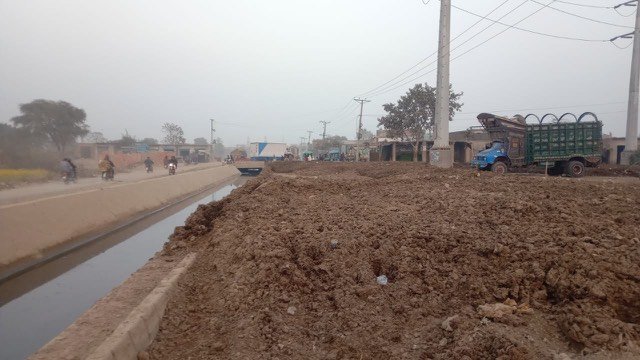
Gujjar Colony, Rakh Chandrai is one of Lahore's largest concentrations of urban dairy farming. Approximately 24,000 mature animals are kept in the settlement, and their daily output of roughly 240 tons of dung was, until recently, discharged and dumped along the roadside.
The consequences were felt every day by the people living there:
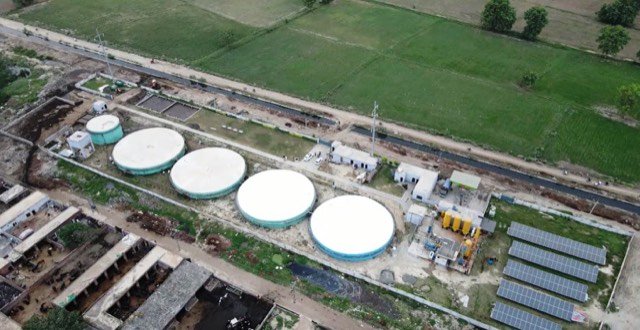
To mitigate the menace of environmental pollution and to improve the health and hygiene of the people, the Government of the Punjab, Energy Department, through Punjab Power Development Company Limited (PPDCL), has installed Pakistan's largest, first-of-its-kind self-sustainable biogas plant with a capacity of 12,000 cubic metres.
The facility collects manure that was previously dumped in the open, digests it in a controlled anaerobic process, and converts it into biogas which is then purified and compressed into fuel-grade gas.
The plant is built around a Continuously Stirred Tank Reactor (CSTR), a proven, internationally established anaerobic digestion technology suited to high-volume manure feedstock.
| Project Title | Installation of Biogas Plant, Gujjar Colony, Lahore |
|---|---|
| Location | Gujjar Colony, Rakh Chandrai, Lahore |
| Executing Agency | Punjab Power Development Company Limited (PPDCL) |
| Sponsoring Department | Energy Department, Government of the Punjab |
| Status | Commissioned March 2026, O&M contract awarded |
| Technology Type | Continuously Stirred Tank Reactor (CSTR) |
| Plant Capacity | 12,000 m³ |
| Feedstock | Cattle manure from the surrounding dairy colony |
| Daily Manure Feeding | 160 Tons |
| Daily Raw Biogas Yield | 8,000 m³ |
| Fuel-Grade Gas Output | 3,200 Kg per day |

Manure is collected from the dairy farms of Gujjar Colony and delivered to the plant, removing it from the roadside and drains.
160 tons of manure is fed into the system each day through a controlled intake.
Inside the 12,000 m³ CSTR digester, the organic material breaks down in an oxygen-free environment, producing raw biogas.
Around 8,000 m³ of raw biogas produced daily is purified and compressed to yield 3,200 kg of fuel-grade gas.
The fuel-grade gas is supplied to nearby industry through cylinder cascades as a clean substitute for imported and conventional fuels, while the digested slurry is available as an organic soil conditioner.
The plant was formally commissioned in March 2026, and the operation and maintenance contract has been awarded.
Fuel-grade gas is delivered to nearby industry through cylinder cascades, replacing conventional and imported fuels.
By capturing methane that would otherwise escape from openly dumped waste, the plant generates approximately 36,000 carbon credits annually.
Before: the roadside canal
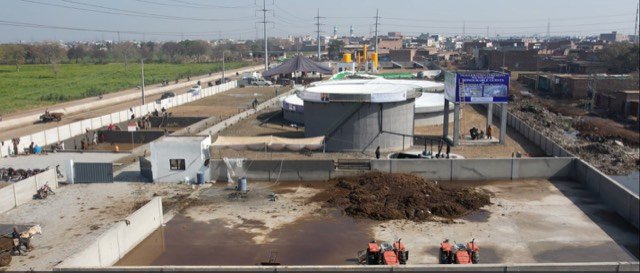 Digester and manure reception area
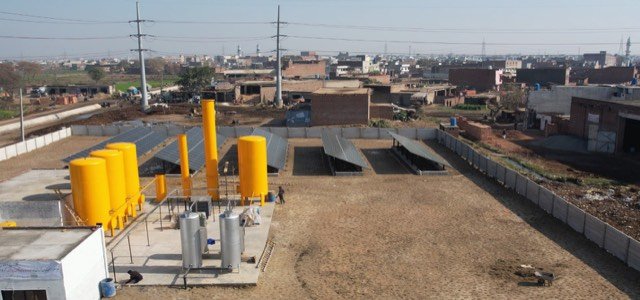 Gas purification and storage
Aerial view of the plant and its solar array
Gas purification and storage
Aerial view of the plant and its solar array
The plant is instrumented and monitored in line with applicable international standards for measurement, safety and hazardous-area equipment, ensuring accurate production accounting and safe operation.
Gujjar Colony proved that urban dairy waste can be converted into a commercially viable stream of clean fuel. The Punjab Biomass Initiative is now taking that model across the province.
See the Rollout Plan