Two village-scale plants at Samundari and Vehari, each supplying gas for the cooking needs of 300 households.
Delivered & Operational
A community biogas plant is owned by the village rather than by any one household. Livestock owners across the settlement contribute manure, the plant digests it, and the resulting gas is distributed for household cooking. The digested slurry is returned to the community as organic fertiliser.
Two such plants have been delivered under the Punjab Biomass Initiative: one at Samundari and one at Vehari. Both were built on land provided by the community itself, and both have taught the Initiative a great deal about what works at village scale and what does not.
Two different engineering approaches to the same problem: one large digester, or many small ones. Together they provide 2,900 m³ of digester capacity, serving 600 households.
Both plants work. But two parts of the original design did not hold up in service, and the Initiative changed its approach as a result. Those changes are set out here because they are the reason the wider rollout is designed the way it is.
| What we found | What we changed |
|---|---|
| Supplying gas through pipelines to individual household cooking points proved not to be feasible at village scale. | Gas is now distributed in cylinders instead of by pipeline. |
| Leaving operation and maintenance to the community itself was found to be unsuitable, as the plants need consistent technical attention. | Operation and maintenance is now outsourced to trained, contracted operators. |
Both changes are already visible in the rest of the Initiative. The Gujjar Colony plant supplies its gas to industry through cylinder cascades and runs under an awarded operation and maintenance contract, and every community plant in the rollout is designed around trained operators and cylinder distribution from the outset.
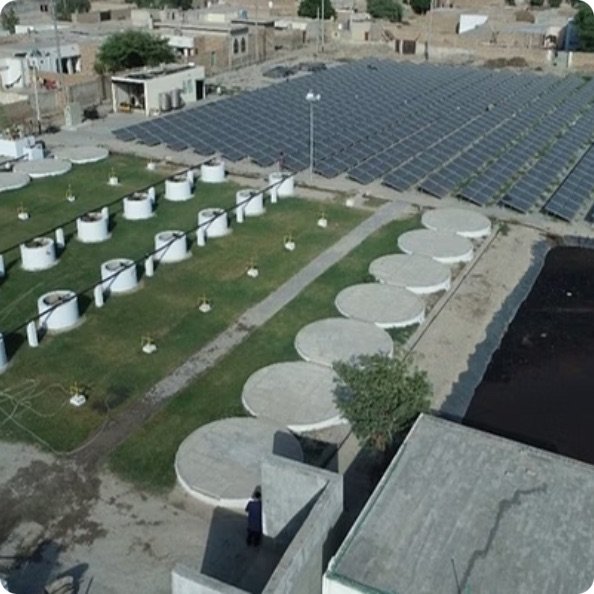 Vehari — fourteen 100 m³ digesters
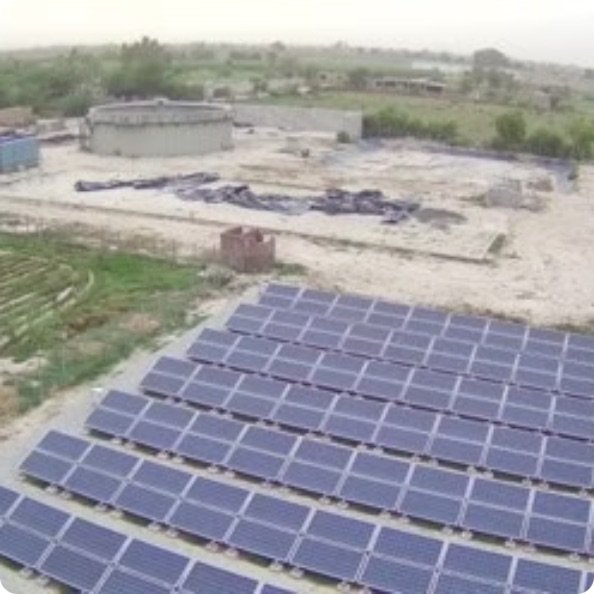 On-site solar keeps the plant self-sufficient
The Punjab Biomass Initiative plans to deliver community biogas plants across 25 districts, serving 110,000 households. Village organisations can register their interest now.
Register Your Village